Bone marrow niche forms innate immune memory
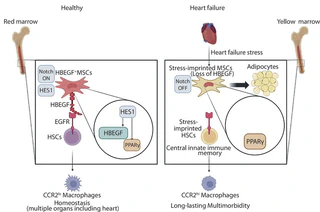
We previously showed that heart failure imprints a “memory” on hematopoietic stem and progenitor cells (HSPCs). Macrophages derived from these HSPCs become proinflammatory and promote recurrence of heart failure as well as diseases in other organs, such as chronic kidney disease and sarcopenia (Stress memory in hematopoietic stem cells). In that study, we found that heart failure impairs sympathetic nerves in the bone marrow and reduces TGF-β signaling from Schwann cells, which contributes to the formation of this memory.
How the bone marrow microenvironment (niche) surrounding HSPCs contributes to this memory, however, remained unknown. In this study, we focused on leptin receptor-positive mesenchymal stromal cells (MSCs), a major component of the bone marrow niche.
MSCs altered by heart failure reprogram hematopoiesis toward inflammation
When MSCs isolated from mice with heart failure were transplanted together with hematopoietic cells from healthy mice, inflammatory macrophages accumulated in the heart and cardiac remodeling worsened, even though the hematopoietic cells themselves had never experienced heart failure. Thus, heart failure stress is also imprinted on MSCs, which in turn change the properties of HSPCs.
Loss of HB-EGF and marrow adiposity
In healthy bone marrow, MSCs receiving Notch–HES1 signaling produce the growth factor HB-EGF, which supports EGF receptor signaling in HSPCs. HES1 also represses PPARγ, a driver of adipocyte differentiation. In heart failure, Notch signaling declines, the HB-EGF-producing MSC subpopulation decreases, and growth factor signaling in hematopoietic cells is suppressed, while an adipogenic program is activated in MSCs. The bone marrow shifts from hematopoietically active “red marrow” toward fatty “yellow marrow”, and HSPCs give rise to proinflammatory CCR2-high macrophages.
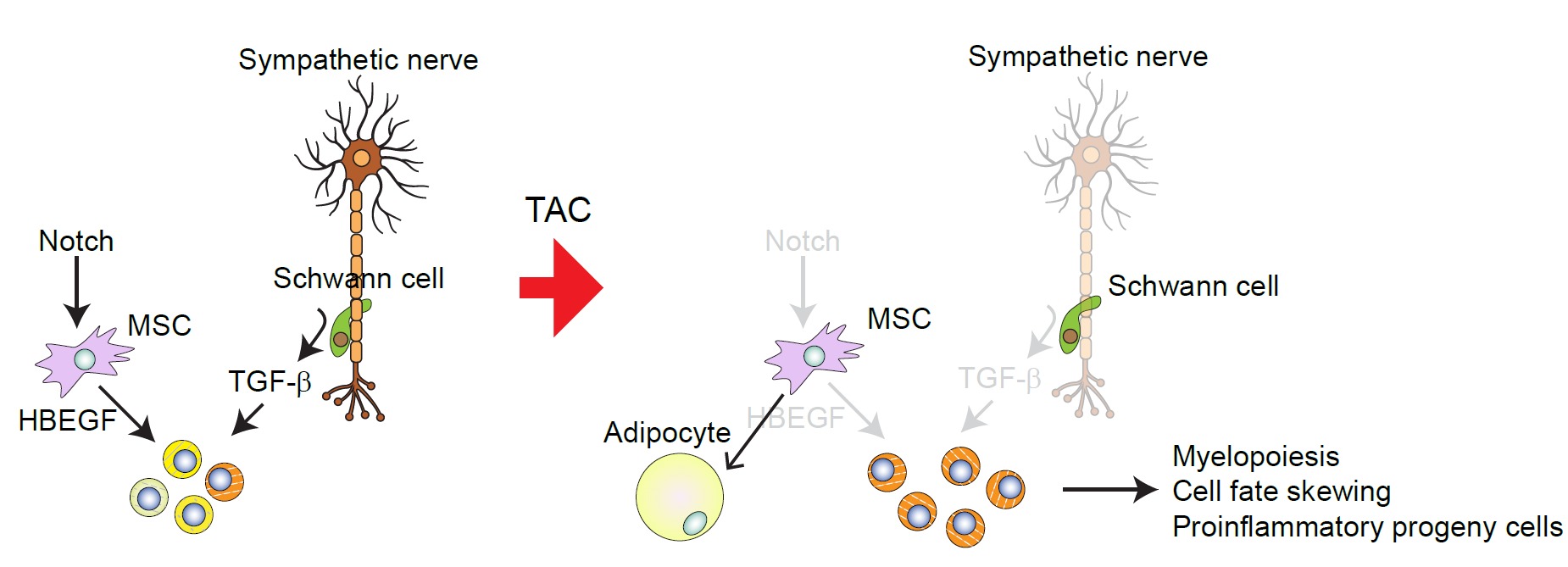
Integrated schematic of our previous and current studies. In the healthy state, TGF-β from Schwann cells along sympathetic nerves and HB-EGF from MSCs support HSPCs. In heart failure (TAC), these signals decline, MSCs are skewed toward adipocytes, and hematopoiesis is skewed toward myeloid, proinflammatory progeny.
Similar changes in humans
Single-cell analysis of human bone marrow revealed an equivalent HB-EGF-expressing stromal subpopulation. CT imaging showed an increased fat fraction in the bone marrow of patients with heart failure.
Significance
This study shows that not only HSPCs themselves but also the bone marrow niche that supports them carries a memory of heart failure, providing a basis for long-lasting inflammation and multimorbidity. HB-EGF signaling and adiposity in the bone marrow niche may be new therapeutic targets for heart failure and its comorbidities.
Goto K, et al. Altered bone marrow niche forms central innate immune memory driving cardiac dysfunction. Nature Communications 17:8261, 2026.
Figures adapted from Goto et al., Nat Commun (2026) (CC BY 4.0)