Bone marrow niche and innate immune memory
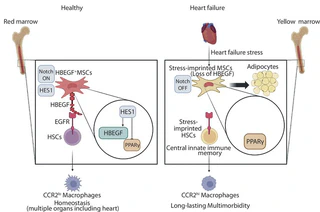
Our paper showing that heart failure remodels the bone marrow microenvironment (niche), which imprints innate immune memory on hematopoietic stem and progenitor cells and worsens cardiac dysfunction, has been published.
We previously showed that hematopoietic stem cells remember heart failure stress, contributing to recurrence of heart failure and impaired stress responses in multiple organs (Stress memory). In this study, we found that leptin receptor-positive bone marrow mesenchymal stromal cells contribute to this memory. Transplanting stromal cells from mice with heart failure together with healthy hematopoietic cells caused inflammatory macrophages to accumulate in the heart and worsened cardiac remodeling. Heart failure reduced a stromal subpopulation producing HB-EGF, suppressed growth factor signaling in hematopoietic cells, and activated a fat-forming program in stromal cells. An equivalent stromal subpopulation exists in human bone marrow, and heart failure was associated with increased bone marrow fat in patients.
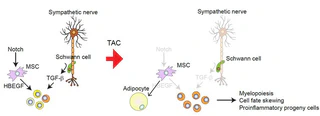
Integrated schematic of our previous study (stress memory) and this study. In the healthy state, TGF-β from Schwann cells along sympathetic nerves and HB-EGF from Notch-activated mesenchymal stromal cells (MSCs) support hematopoietic stem and progenitor cells. In heart failure (TAC), these signals decline, MSCs are skewed toward adipocytes, and hematopoietic stem and progenitor cells give rise to myeloid-biased proinflammatory progeny.
Figures adapted from Goto et al., Nat Commun (2026) (CC BY 4.0)