
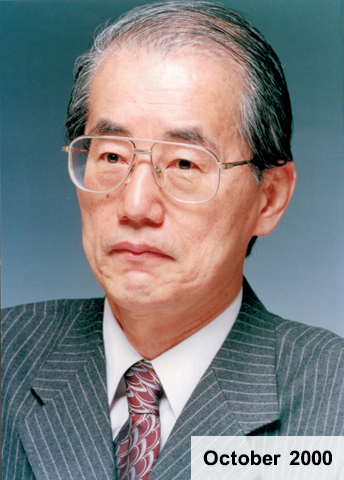


Shunichi Araki MD, DrMSc, MSc, DIH (As in September, 2012)
Professor Araki was appointed a Fellow of the Collegium Ramazzini (CR) in 1990, after the visit of Prof.
Irving Selikoff, CR Founding President, and Prof.
Philip Landrigan, Present President, to Tokyo, Japan. Since 1987 he had served Professor and Chairman of the Department of Public Health at the School of Medicine of the Faculty of Medicine, The University of Tokyo.
Last year he was appointed an Emeritus Fellow of the CR.
This is a short report on his career in research, education, and governmental and public activities for these 22 years.
(I) RESEARCH His own English-written first-author original papers since graduation in 1966 from The School of Medicine, The University of Tokyo were mainly on: (1) Subclinical neurophysiological effects and methods in occupational and environmental health, e.g. peripheral nerve conduction, evoked potentials, and event-related potential (P300) studies in lead workers, (2) Mobilization of lead and other metals into the plasma and urine by CaEDTA, an effective chelating agent, (3)Assessment of body burden of chelable lead in relation to blood lead in lead workers and unexposed people, and (4) Renal excretory mechanisms of lead, other metals, and organic substances into the urine of humans, and (5) Adjustments of urinary concentrations of those metals and substances into urinary volume also in humans.
Otherwise, a wide variety of epidemiological, psychosomatic, and immunological papers in occupational, environmental, and community health were published with his young colleagues and doctor-course students.
All those peer-reviewed original papers amounted to 231 papers in English and 67 in Japanese.
In 1991, he organized two international symposia at the University of Tokyo, i.e., (1) The 4th Symposium on Neurobehavioral Methods and Effects in Occupational and Environmental Health, co-organized with ICOH, WHO and ILO, and (2) The 12th International Symposium of The University of Tokyo, entitled Behavioral Medicine: Biobehavioral Approach to Health and Illness.
The two Symposium Proceedings were published as Monographs by Academic Press (1994) and Elsevier Publishers(1992), respectively.
Otherwise, he served Chairman of the ICOH Scientific Committee on Neurotoxicology and Psychophysiology(1993-2000), Editor-in-Chief of INDUSTRIAL HEALTH(2000-09) and Associate Editors of ENVIRONMENTAL RESEARCH(since1990), AMERICAN JOURNAL OF INDUSTRIAL MEDICINE(since 1992), and INTERNATIONAL JOURNAL OF BEHAVIORAL MEDICINE(1993-8).
He has also served an Honorary Director of Sanlian Accident Prevention Institute in China since 1991.
(II) HIGHER EDUCATION
He chaired the Department of Public Health of the Graduate School of Medicine at The University of Tokyo until 2001(the duty in the last year was an adjunct position).
During this period, as the Department chair, he educated about 100 medical students for public health every year, and on average eight post-graduate doctor course students for the degree of Doctor of Medical Sciences(Dr.Med.Sc.).
As a result, 20 doctor course students and 11 extramural students were awarded the Dr.Med.Sc. by The University of Tokyo under the guidance of Department chair, himself.
Among the doctor course students, 6 students became Professors of the Kyoto and 3 other National Universities, a private university, and a university in China; one was invited to Director of a governmental research institution; two opened medical clinics; two became dental practitioners, etc.
Current positions of the extramural students are Professor Emeritus of the Tsukuba University, Director General of Tuberculosis Research Institute, Director of JNIOSH , Director General of the Ministry of Agriculture, Forestry and Fishery, Lawyer, etc.
Otherwise, He has been an Adjunct Professor at the Department of Preventive Medicine of the Mount Sinai School of Medicine, New York, since 1991, and Visiting Professors at Juntendo Medical School in Tokyo and two national universities in Western Japan for these several years.
(III) GOVERNMENTAL AND PUBLIC ACTIVITIES
In 2000, he was appointed Director General of the National Institute of Industrial Health(NIIH) in the Ministry of Labour, Japan.
Next year, following the progress in a governmental reform, the Institute became a semi-governmental Independent Administrative Institution with his position changed to President.
In 2006 the NIIH and the National Institute of Industrial Safety, another semi-governmental Institute, were integrated into the JNIOSH and he was appointed a new President.
In 2008 he served a Delegate for the first World Summit on Safety and Health at Work (ILO).
Next year he retired from the JNIOSH, and served Directors of two public institutions, i.e. Saitama Occupational Health Promotion Center of the Japan Labour Health and Welfare Organization and Espoir Tokorozawa Geriatric Health Care Institution.
(Collegium Ramazzini:CR Fellowship for 22 years, 2012)